Putin agrees to European participation in next Ukraine peace talks
US envoy Steve Witkoff said on 12 November that Vladimir Putin agreed to let European representatives join the next round of Ukraine peace talks.
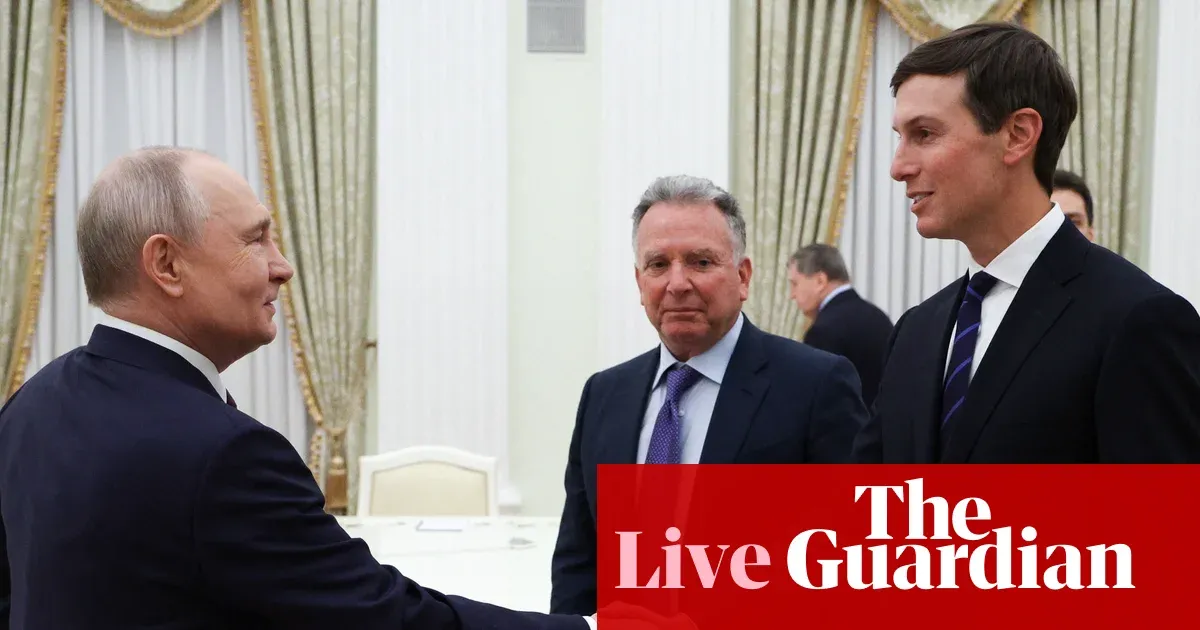 Photo: The Guardian
Key points
Vladimir Putin agreed on 12 November to let European representatives join the next round of Ukraine peace talks, US envoy Steve Witkoff said.
US envoy Steve Witkoff said on Thursday that Vladimir Putin agreed to let European representatives join the next round of Ukraine peace talks, after Witkoff and Jared Kushner met the Russian president. Witkoff told reporters before leaving Moscow: "The Europeans will join at the next meeting, which we consider to be a very important moment because they are our partners and it's important to us that they take part."
The meeting came a day after two days of trilateral talks in Abu Dhabi between Russia, Ukraine and the US ended on 11 November without a breakthrough and without European officials joining. Witkoff said: "People didn't think that we were going to restart trilateral. We've restarted it; we've set a new meeting now on top of that, and this is what President Trump wants to see." The Abu Dhabi talks were the first direct US-mediated negotiations between Russia and Ukraine in nine months.
What Witkoff announced
The Kremlin said the talks between Putin and the two US envoys had been useful and that the American side had supported Putin's proposal for a joint humanitarian mission to a city in eastern Ukraine. Kremlin aide Yuri Ushakov said Putin would continue discussions on Ukraine with US President Donald Trump at an Apec summit in China later this month and that direct peace talks with Ukraine, which resumed this week after a pause of nine months, would continue.
Putin said Moscow had always been open to talking to the EU about Ukraine but signalled serious outstanding differences. "As far as the Europeans are concerned, we have never been opposed to engaging in dialogue with Europe, and we have never broken off that dialogue. It was they who broke off the dialogue with the Russian Federation," he said. He warned that the European idea of sending Western troops into Ukraine once a peace deal was concluded would trigger a resumption of the war.
Putin said Washington must work with its European allies to understand if they want peace or war in Ukraine. "We would very much like you, gentlemen, and the US administration as a whole, to work with your European allies so that they can finally make up their minds as to what they want: peace or war in Ukraine," he said. Kushner told Putin that Washington had detected what he called "a big change" in the European side. He was confident that expanding peace talks would not hinder progress.
Putin's conditions
The main outcome of the Abu Dhabi talks was agreement on a major exchange of prisoners of war likely to take place in the coming weeks. Serious unresolved issues remain, including differences over territory, with Russia holding about one fifth of Ukraine and Kyiv refusing to give up the rest of the Donbas region in its east. Putin has shown no signs of being ready to moderate his territorial demands, which include a buffer zone in parts of Ukraine which Russia has not formally claimed.
Ukrainian President Volodymyr Zelenskyy pressed EU governments to step up participation in the negotiations as he talked with world leaders hours before he was due to hear about the Moscow discussions. "When the Americans and the Russians talk about this, it's not just about security guarantees for Ukraine," he told leaders at the start of a summit in Dublin. "It's more about some kind of new security framework between Europe and Russia." He said "we need to make sure that Europe becomes a regular part of this negotiation."
EU governments continue to disagree over who would represent them in any peace negotiations. EU foreign policy chief Kaja Kallas said EU treaties signal that European Council President António Costa and she should represent the bloc, a solution backed by Estonian Prime Minister Kristen Michal. French President Emmanuel Macron said Europe must first agree on its own peace proposals and vision for future European security before deciding who should represent it.
Europe's response
German Chancellor Friedrich Merz said he had received positive signals from the Abu Dhabi talks but stressed that Ukraine and Europe must be involved. "I expect the Russian government and the Russian president to finally agree to these joint talks," Merz said. "We will also discuss who, if necessary, will represent the European Union. But that is a matter we will discuss behind closed doors and not air publicly." The issue is set to be discussed at Friday's informal European Council following Italian Prime Minister Giorgia Meloni's request.
Zelenskyy also said new restrictions were affecting the US-made satellite communications Kyiv uses on the battlefield. In a post on Telegram, he said systemic restrictions were limiting the speed at which Starshield could be used, and Ukrainian interceptors could not reach sufficient speed to down Russian jet-powered drones. "So far we know very little on the Starshield restrictions. But some things are already clear: if someone in America is making decisions that basically treat Ukrainian territory as if it is not Ukrainian, then it tells us where things are going," he said.
Putin told the US envoys that Russia was proposing a joint Russian-Ukrainian humanitarian mission to Kostiantynivka in eastern Ukraine, which he said Moscow controlled. Putin said the mission could be modelled on an initiative that allowed residents to leave the Russian-controlled town of Oleshky at the end of last month. Russia needed five days to clear the area near Kostiantynivka of mines, Putin said, saying there were 400-500 residents still there.
Witkoff and Kushner were expected to meet Zelenskyy in Dublin on Thursday to update him on the Moscow talks. The Kremlin said Putin would continue discussions on Ukraine with Trump at an Apec summit in China later this month, and Ushakov said Russia had made clear to the US envoys that Nato could not expand further and expressed hope that Europe would support talks on a new European security architecture.
Frequently asked questions
What did Putin agree to on Thursday?
Putin agreed to let European representatives join the next round of Ukraine peace talks, US envoy Steve Witkoff said after meeting the Russian president with Jared Kushner.
Why is European participation in the talks significant?
Europe was not represented at the Abu Dhabi trilateral talks that ended on 11 November. Witkoff called European participation 'a very important moment' because 'they are our partners and it's important to us that they take part.'
What did Zelenskyy say about the talks?
Zelenskyy pressed for Europe to become a 'regular part' of the negotiation, saying the talks were about 'some kind of new security framework between Europe and Russia.' He also reported new restrictions on Starshield satellite communications.