ICJ rules Myanmar committed genocide against Rohingya, refugees in Cox's Bazar say
The International Court of Justice ruled on 19 November that Myanmar committed genocide against the Rohingya, killing about 10,000, and refugees in Cox's Bazar called it a small victory.
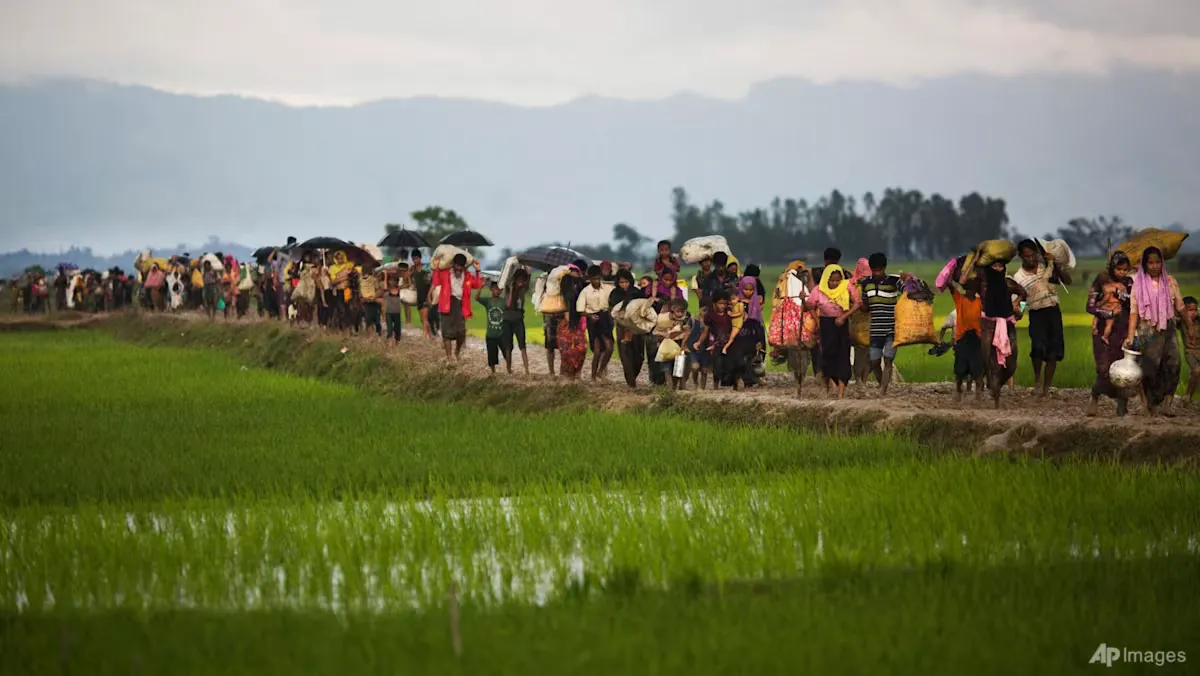 Photo: Channel NewsAsia
Key points
The International Court of Justice ruled on 19 November that Myanmar committed genocide against the Rohingya, and refugees in Bangladesh welcomed the verdict while demanding they be allowed home.
Hundreds of Rohingya refugees in Bangladesh watched on a big screen at their camp in Cox's Bazar as the International Court of Justice ruled on 19 November that Myanmar committed genocide against the Rohingya minority in a 2017 military operation. The court said evidence showed Myanmar forces killed about 10,000 Rohingya. Many called the verdict a "small victory" and said they would be "fully satisfied" only when they could return safely to their homes across the border.
The Hague-based court found Myanmar responsible for genocide, the first time it has ruled that a state committed the crime. It ordered Myanmar to allow the Rohingya to return home safely, pay reparations to the Rohingya Muslims and prosecute those suspected of having committed genocide. The court's rulings are legally binding, though it has no way to enforce them beyond reporting non-compliance to the UN Security Council.
What the court ordered
The court said evidence showed Myanmar forces killed about 10,000 Rohingya. Under the 1948 convention, to establish that genocide occurred, the court had to find that there was an intent to destroy the Rohingya "in whole or in part". The judgment found that intent, holding that Myanmar was trying to destroy the group as a people rather than merely carrying out ethnic cleansing.
In August 2017, Myanmar's military launched what it called a clearance campaign in Rakhine state in response to an attack by a Rohingya insurgent group. The campaign led to accusations that security forces committed mass rapes and killings and burned thousands of homes. More than 700,000 Rohingya fled to Bangladesh, according to the court, settling in what has become the world's largest refugee camp.
Why the ruling matters
About 1.2 million Rohingya refugees now live in Bangladesh, primarily in crowded camps across Cox's Bazar district. There they endure harsh conditions marked by fire hazards, infectious diseases, monsoon landslides, inadequate sanitation and strict work restrictions. Bangladesh has been urging the international community to help repatriate the refugees. Mohammad Rofik, a Rohingya community leader at the camp, said the verdict was "a victory" for them because it recognised the genocide and the suffering of their minority in the Buddhist-majority nation, but that it was "not an end" to their ordeal. "Justice has started," Rofik said, adding that the Rohingya still have "a long way to go".
Sayed Ullah, another Rohingya community leader, said the verdict was a historic recognition that the Rohingya are a distinct ethnic group. "Myanmar denies the existence of the Rohingya, but now the (UN) court made it clear," he said. Other refugees reacted sharply, saying the international community should punish Myanmar authorities.
Mohammad Osman, a Rohingya refugee, said the court had established that genocide was committed against the Rohingya people. "Based on this ruling, the entire Rohingya community is calling on ... (the world) to impose severe punishment on Myanmar," he said. Rohingya activist Rohimullah said the announcement was difficult to put into words and reminded him of those the community had lost.
Myanmar rejects the judgment
Myanmar's government on 20 November dismissed the ruling as "unfair". The military has insisted the Rohingya burned their own homes, and the government has said there was no direct evidence of genocidal intent. The court has no way to enforce its rulings beyond reporting non-compliance to the UN Security Council, so how much of the judgment can be implemented remains open.
Bangladesh Foreign Minister Khalilur Rahman, who is also president of the UN General Assembly, went to Cox's Bazar on 20 November to tell Rohingya who fled the genocide that "at this historic moment" there must be action, his UN spokesperson said. Suspects must be prosecuted, the Rohingya must be able to return voluntarily and safely, and they must receive reparations, Rahman said, according to spokesperson Melissa Summers.
Rahman also said he will advocate with UN member nations on how to follow up on the judgment, stressing "You will not be alone," Summers said. The court said Myanmar must allow the "safe and dignified return to their place of residence and the reunification of families for the Rohingya displaced as a result of Myanmar's wrongful acts". It also said Myanmar had an obligation to compensate the Rohingya, to be determined at a later date.
Nasir Uddin, a professor of anthropology at the University of Chittagong who researches the Rohingya crisis, said the ruling was important to ensure justice and accountability from the victims' perspective. "In the 21st century, we talk about liberal democracy, globalisation and global justice. Yet such a massive genocide happened before our eyes. The judgement was essential to establish the concept of global justice," he said.
The celebrations came against a backdrop of difficult living conditions. Rain fell over the camps on 19 November as Cyclone Akvan bore down on the Bay of Bengal, adding to the discomfort of families living in cramped shelters. Eighteen-year-old Mohammad Rehan, who watched with his community teacher and friends on a laptop, said some women were crying while others prayed to Allah.
Frequently asked questions
What did the International Court of Justice rule on Myanmar?
The court ruled on 19 November that Myanmar committed genocide against the Rohingya in a 2017 military operation, the first time it held a state responsible for genocide. It ordered Myanmar to allow the Rohingya to return safely, pay reparations and prosecute suspects.
How many Rohingya refugees live in Bangladesh?
About 1.2 million Rohingya refugees now live in Bangladesh, primarily in crowded camps across Cox's Bazar district. More than 700,000 fled there after the 2017 military campaign, according to the court.
Can the ICJ enforce its ruling against Myanmar?
The court's rulings are legally binding, but it has no way to enforce them beyond reporting non-compliance to the UN Security Council. Myanmar's government dismissed the ruling as unfair on 20 November.