Spain's transport minister resigns after train crash that killed 69
Óscar Puente resigned on Tuesday, six days after a high-speed train collision near Urda killed 69 people, Spain's worst rail disaster since 2013.
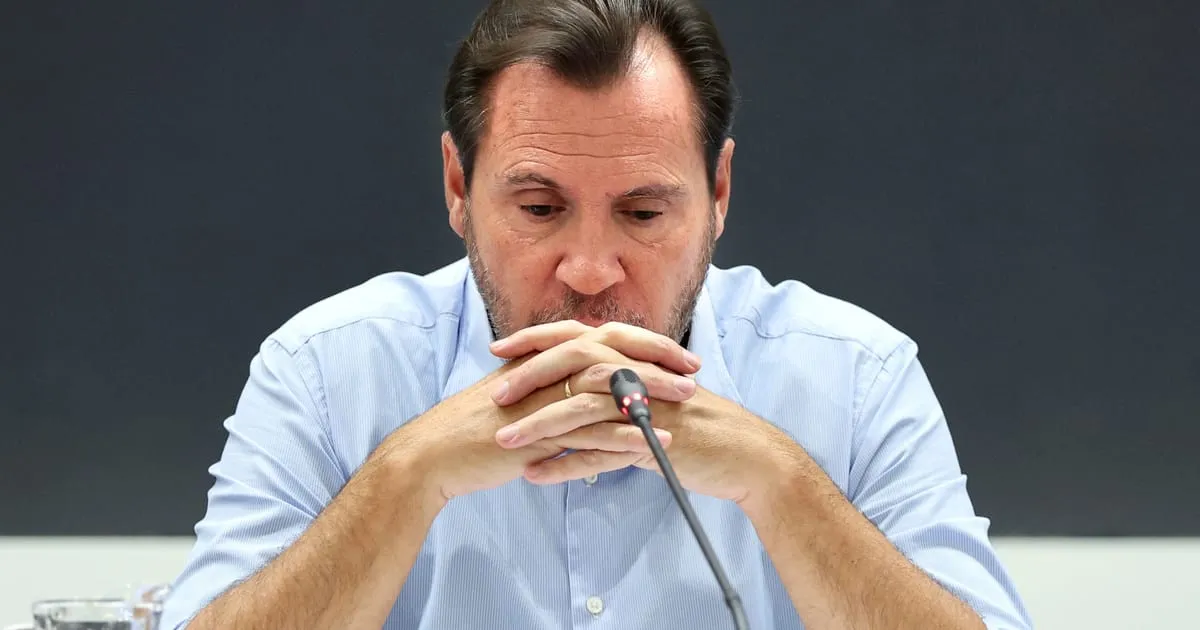 Photo: POLITICO
Key points
Spain's transport minister resigned after a train crash that killed 69 people, and he withdrew from the election list.
Spain's transport minister, Óscar Puente, resigned on Tuesday evening, six days after a high-speed train collision near Urda killed 69 people and injured dozens. He announced his decision in Congress after giving evidence on the disaster, which happened on 28 October. Puente, a member of Prime Minister Pedro Sánchez's Socialist party, said stepping down was "good for the country and for democracy".
Puente had denied any intent to leave the government for days, but his resignation came after an hours-long grilling by the Parliament's standing committee, which acts for the Parliament while it is dissolved ahead of the 29 November snap election. He also said he would not stand as a candidate, telling lawmakers: "I wish to inform you that I am not only stepping down from my position as minister of transport, but that I am also withdrawing my name from the lists for the early legislative elections."
Resignation and election withdrawal
The crash was Spain's worst rail disaster since 2013 and one of the worst in Europe's modern history. It was the second deadly rail accident in Spain this year, after a derailment near Adamuz in January killed 46 people. Both accidents happened on the Madrid-Seville high-speed line. Puente had held the post since 2023.
During the congressional session, Puente defended the safety of the Madrid-Seville line, saying: "It is neither an abandoned nor a forgotten piece of infrastructure." He pointed to a €780 million renewal plan launched by the government. He ended his speech with a farewell: "I trust my country will live up to the occasion. I have tried to live up to it. Farewell."
The collision involved a train run by state-owned operator Renfe with 397 passengers on board and a stationary train run by private operator Iryo, which was carrying 147 passengers. Iryo said its carriages were "struck from behind" by the other train. A reported issue with the automatic signalling system, a computer failure, had forced all trains to halt on the affected stretch.
Signalling failure and audio recordings
Leaked audio recordings published in Spanish media soon after the crash revealed conversations between train drivers and a control centre just minutes before the disaster. The three recordings appear to show that the Renfe train was given clearance to move even though the other train had stopped on the track, about 25km (15 miles) ahead. In one, a control operator tells the Renfe driver: "Continue your journey and then proceed under [Lateral Signalling Block], at normal speed with normal operation."
The Lateral Signalling Block is a back-up system used when the automatic signalling or data transmission system fails. The driver of the stationary Iryo train says in another recording that communication with the train-control system has been lost, and it is not moving. The driver later contacts the control centre again, saying: "The train won't allow me to control the [security] system. That's why I am still stopped in front of the entry signal."
Puente told MPs that the control centre run by Adif, Spain's state-owned rail infrastructure manager, had allowed the AVE high-speed train to continue its journey even though its LZB automatic safety system had failed. The AVE then travelled about 25 kilometres at more than 160 km/h before the collision. Puente said last week that the decision to instruct the trains to move again, without any speed restrictions, was "inexplicable".
Opposition and strike threat
Opposition parties attacked Puente. Ester Muñoz, spokesperson for the conservative People's Party, said the minister's job "is not to explain fatal accidents, it is to prevent them". Pepa Millán, spokesperson for the far-right Vox party, accused Puente of "shirking his responsibilities" and said: "He has neither dignity nor shame." The PP and Vox had demanded his resignation, as had the Basque Nationalist Party and the Catalan pro-independence party Junts.
Meanwhile, the works council at Adif has agreed to push for a strike on 17 November to demand better rail safety, although the strike has not yet been formally called. The planned protest reflects growing concern about the safety of Spain's high-speed network after two deadly crashes in less than a year. Puente's resignation comes as a blow to the Socialist-led government ahead of the general election set for 29 November.
Frequently asked questions
Why did Spain's transport minister resign?
Óscar Puente resigned on Tuesday, six days after a high-speed train crash near Urda killed 69 people. He said a transport minister cannot remain in office after two serious accidents in less than a year, and he also withdrew from the election list.
What caused the Urda train crash?
A reported computer failure in the automatic signalling system forced all trains to halt. Leaked audio recordings suggest the Renfe train was cleared to move even though the Iryo train was stopped ahead. The AVE travelled about 25km at more than 160 km/h before the collision.
When is the strike at Adif planned?
The works council at Adif has agreed to push for a strike on 17 November to demand better rail safety, although the strike has not yet been formally called. It reflects concern after two deadly crashes in less than a year.