Volt Typhoon ran four zero-day campaigns through Silent Train relays
Black Lotus Labs reported on 28 October 2026 that Volt Typhoon used the Silent Train framework, rotating compromised devices rebuilt in under two minutes, to exploit at least four zero-day flaws in edge and management systems.
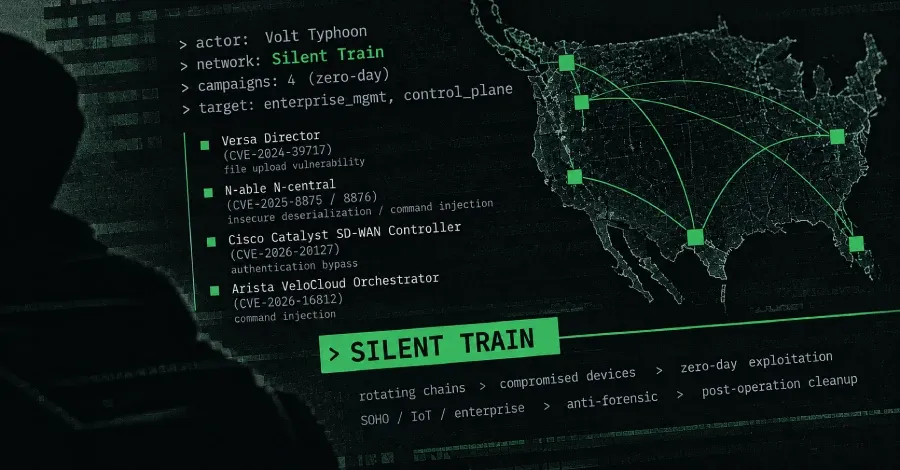 Photo: The Hacker News
Key points
Volt Typhoon used the Silent Train framework of rotating compromised devices to exploit at least four zero-day vulnerabilities in edge and management infrastructure, Black Lotus Labs reported on 28 October 2026.
Volt Typhoon used a covert framework called Silent Train to hide at least four zero-day exploitation campaigns targeting edge and management infrastructure, Black Lotus Labs reported on 28 October 2026. The framework relies on rotating chains of compromised devices, rebuilt in under two minutes, that route attacks through relays before striking high-value systems such as telecommunications firms, government agencies and utilities.
The finding matters because it shows how a state-sponsored group preserves access to hundreds of sensitive networks without leaving a stable footprint to disrupt. Black Lotus Labs, the threat research division of communications company Lumen, has tracked Silent Train for three years and confirmed Volt Typhoon exploited at least four zero-day vulnerabilities. The framework was named Silent Train because the actor uses it against select targets, cleans it up after each operation, and refreshes it continuously.
How Silent Train hides attacks
Silent Train is a relay infrastructure formed of compromised devices that hides the origin of attacks. Operators route activity through virtual private server infrastructure outside the United States, then pass it through hacked routers acting as intermediate relays before launching attacks. Intelbras modems served as overseas relays, while Netgear Orbi devices acted as hops inside the United States, Black Lotus Labs said.
The operators exploit exposed web interfaces on small office home office, internet of things and other relay devices, then deploy only the tooling needed to enable chained secure shell access through the compromised node. This included temporary secure shell services, keys, configuration files, and live-off-the-land utilities. After the session ends, typically in under eight hours, the actors remove all tooling, keys and configuration files from the disposable relays.
Black Lotus Labs observed zero-day exploits for five products: CVE-2026-16812 in VeloCloud Orchestrator, CVE-2026-20127 in Cisco Catalyst SD-WAN, CVE-2025-8875 and CVE-2025-8876 in N-able N-central, and CVE-2024-39717 in Versa Director, with Quest KACE a suspected zero-day. Compromising these platforms gives broad administrative control, enabling credential theft, remote access, and reach into downstream customers without the noisy lateral movement that might trigger detection.
The four zero-day campaigns
By early 2025, researchers noticed the framework became hybrid, using disposable relays alongside compromised enterprise systems retained between one and three months. Volt Typhoon has exploited and abused more than 27 device classes, including edge devices, enterprise management tools, identity and access management systems, and networking infrastructure, from vendors including Fortinet, Cisco, ManageEngine, Ivanti, F5, Check Point, Palo Alto Networks, ServiceNow, TP-Link, Netgear and ArcGIS.
Michael Horka, principal information security engineer at Black Lotus Labs, said individual chains are assembled and dismantled every day, with infrastructure continually refreshed. The group rebuilt a new chain with different infrastructure in less than two minutes, making the number of nodes at any one moment effectively close to zero. Sessions averaged roughly four hours, with extensive cleanup and compartmentalisation, Horka said.
Black Lotus Labs has notified hundreds of victims since first identifying Silent Train activity, including telecom providers, government entities, defense contractors, universities and IT firms, plus organisations in water, energy, transportation, maritime, rail, aviation and emergency services. The most targeted regions were California, Texas and Hawaii, suggesting a focus on Indo-Pacific matters. Horka cautioned that the ephemeral framework means observations should not be read as a complete census of activity.
Who was targeted and why
Silent Train's deployment was partly fueled by the FBI's disruption of the KV-Botnet, a botnet Volt Typhoon used to evade detection when attacking critical infrastructure in the United States. The group relied more heavily on Silent Train after the FBI and Justice Department disrupted the KV Botnet in early 2024. Volt Typhoon previously targeted U.S. communications, energy, transportation and water systems.
Black Lotus Labs believes Silent Train was reserved for high-value targets and careful, hands-on operations conducted on China Standard Time, with zero-day use against those targets strengthening that assumption. The researchers recommend strengthening security around centralized management systems, restricting internet access to administrative interfaces, rapidly patching vulnerabilities, and centralizing logs with longer retention, alongside monitoring for unusual administrative activity.
Why disruption is hard
Horka said the framework is fundamentally difficult to disrupt because there is not one network to take down, and what exists today will be completely different tomorrow. Removing individual pieces is possible, but removing the actor's ability to continuously rebuild them is a much harder problem to solve, he said. Researchers recommend following CISA and NCSC guidance on Volt Typhoon.
Frequently asked questions
What is Silent Train?
Silent Train is a framework of rotating chains of compromised devices that Volt Typhoon uses to hide the origin of attacks, routing activity through virtual private servers outside the United States and hacked routers before striking targets.
Why is Silent Train hard to disrupt?
Michael Horka of Black Lotus Labs said chains are assembled and dismantled every day and rebuilt in under two minutes, so there is not one network to take down, and what exists today will be completely different tomorrow.