Zelensky says US intelligence sharing works now after Oslo talks
Ukrainian President Volodymyr Zelensky said on 20 October 2026 in Oslo that US early-warning intelligence sharing "works now" after talks with envoy Steve Witkoff, as Kyiv pressed for Patriot interceptors and Starshield access.
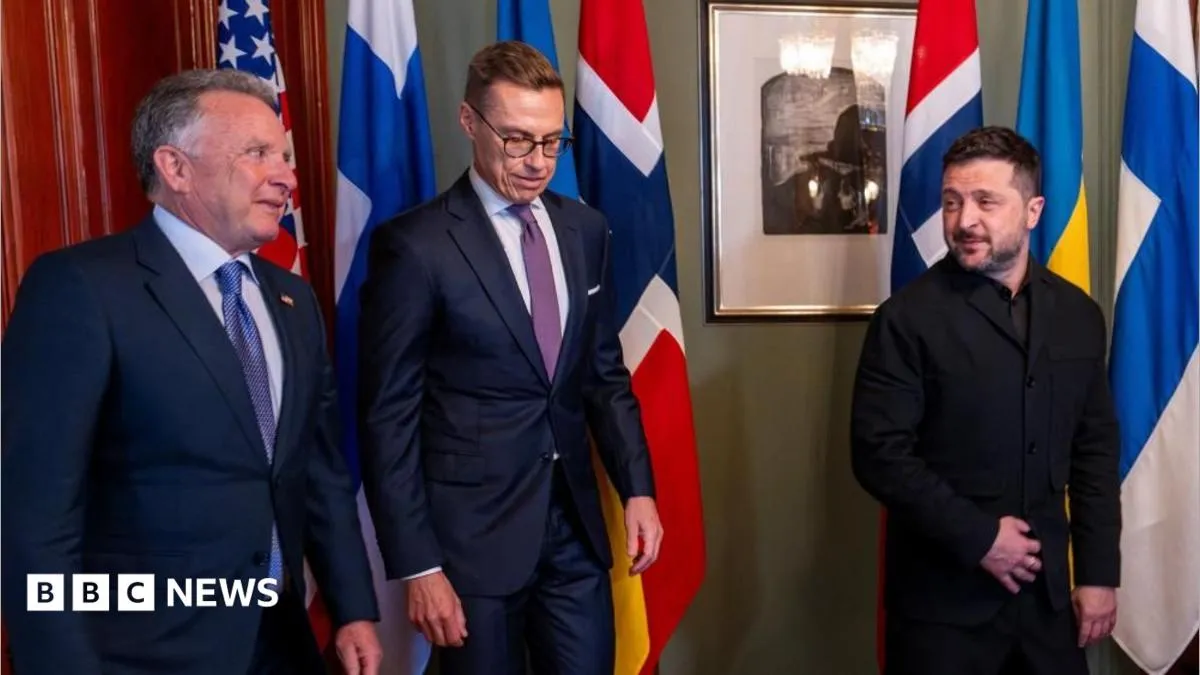 Photo: BBC News
Key points
Zelensky said US intelligence sharing on incoming Russian missiles "works now" after 20 October 2026 talks in Oslo with US envoy Steve Witkoff.
Ukrainian President Volodymyr Zelensky said on 20 October 2026 in Oslo that US intelligence sharing on incoming Russian missile attacks "works now", after talks with US special envoy Steve Witkoff and Jared Kushner, who joined by video link. Zelensky said he was "thankful that intelligence works now", adding that early warning lets civilians hear when ballistic missiles are coming.
The statement marks a shift from Kyiv's accusations in the days before the meeting that Washington was withholding key intelligence — a claim US Secretary of State Marco Rubio rejected as "scandalous". The talks in the Norwegian capital brought together Zelensky, Witkoff, Finnish President Alexander Stubb and Norwegian Prime Minister Jonas Gahr Støre, and produced what Stubb called "genuine progress" on proposals to achieve peace, though he gave no details and warned patience would be needed.
What the Oslo talks changed
The dispute over intelligence sharing intensified after Ukrainian officials said they received no advance warning of Russian ballistic missile and drone strikes on energy infrastructure in the capital region. Zelensky said on 19 October 2026 that Ukraine received no early warning of those attacks. Russian drone attacks continued on 20 October, with Ukrainian officials saying at least 10 people were killed — four in Kyiv and the capital region, four in the eastern Donetsk region and two in the central city of Dnipro.
Ukraine has also reported reduced speeds on Starshield, the US military satellite system it uses for battlefield communications and strikes on Russian-occupied territory. Trump denied ordering a reduction in speeds on the US government-owned network, after SpaceX chief Elon Musk said the order could only have come from the White House. Zelensky said on 20 October that "we decided that maybe in 48 hours we will have again a connection" on Starshield.
Where the intelligence dispute came from
Zelensky told US senators on 19 October that "the Pentagon is delaying the delivery of missiles" already paid for by European countries, and that the shipment was waiting for US Defence Secretary Pete Hegseth's signature. He said several European countries were ready to transfer Patriot interceptor missiles from their own stockpiles but were still awaiting US approval. Rubio, visiting India, acknowledged on 20 October that Patriot interceptors may not yet have arrived in Ukraine, but stressed nothing had been denied to Kyiv intentionally.
Finnish President Stubb said "some elements of peace" from the Oslo discussions would be taken forward to St Petersburg. Norwegian Prime Minister Støre said Witkoff would fly to St Petersburg the following day to meet the Russian leadership and exchange ideas from the meeting and proposals worked on by European and American colleagues. A US official described the talks as "very productive and constructive", citing "strong alignment at the working level" among the US, Ukraine and Europe on next steps.
Kremlin spokesperson Dmitry Peskov said on 20 October that Russia hoped to arrange a meeting soon so Witkoff could brief President Putin on his contacts with Ukrainians and Europeans. Foreign Minister Sergei Lavrov earlier said the Kremlin would listen to what Witkoff would offer while ruling out "any political concessions". Putin had not publicly commented on the latest developments as of 20 October.
What remains unresolved
Relations between Washington and Kyiv have soured, with Trump saying it was time for Ukraine to get a new president and, most recently, "for somebody else to negotiate on behalf of Ukraine". Speaking at the White House on 20 October, Trump said Ukraine had to "make a deal" and that it was "time for Ukraine to end this war". Zelensky insisted that any talks about Ukraine's future required Kyiv at the table.
Zelensky restated that Ukraine was "ready for negotiations" to end the war, saying "we are not losing this war, but we are losing people because Russia attacks". He said strong security guarantees for Ukraine and energy ceasefire proposals were also discussed in Oslo. Norwegian Prime Minister Støre stressed that Europe "needs to be at the table" during any discussions about how to end the war.
Witkoff was due to meet Putin in St Petersburg the day after the Oslo talks to discuss the proposals, with Kushner again participating virtually. Zelensky said he hoped to speak with Rubio within 48 hours. European leaders expressed concern about recent US statements, with German Chancellor Friedrich Merz speaking of "mixed pictures and messages" on the war.
Frequently asked questions
What did Zelensky say about US intelligence sharing after the Oslo talks?
On 20 October 2026 in Oslo, Zelensky said US intelligence sharing on incoming Russian missile attacks "works now", adding he was "thankful that intelligence works now" and that early warning lets civilians hear when ballistic missiles are coming.
Who took part in the Oslo talks on 20 October 2026?
The talks brought together Zelensky, US special envoy Steve Witkoff, Jared Kushner (via video link), Finnish President Alexander Stubb and Norwegian Prime Minister Jonas Gahr Støre.
What happened to Starshield satellite access for Ukraine?
Ukraine reported reduced speeds on Starshield, the US military satellite system it uses for battlefield communications. Trump denied ordering the cut. Zelensky said on 20 October he hoped connection would be restored within 48 hours.