BepiColombo enters Mercury orbit after eight-year journey, ESA confirms
The European-Japanese spacecraft began orbiting Mercury on 21 November after an eight-year journey, ESA confirmed, though a software issue made a thruster burn shorter than planned.
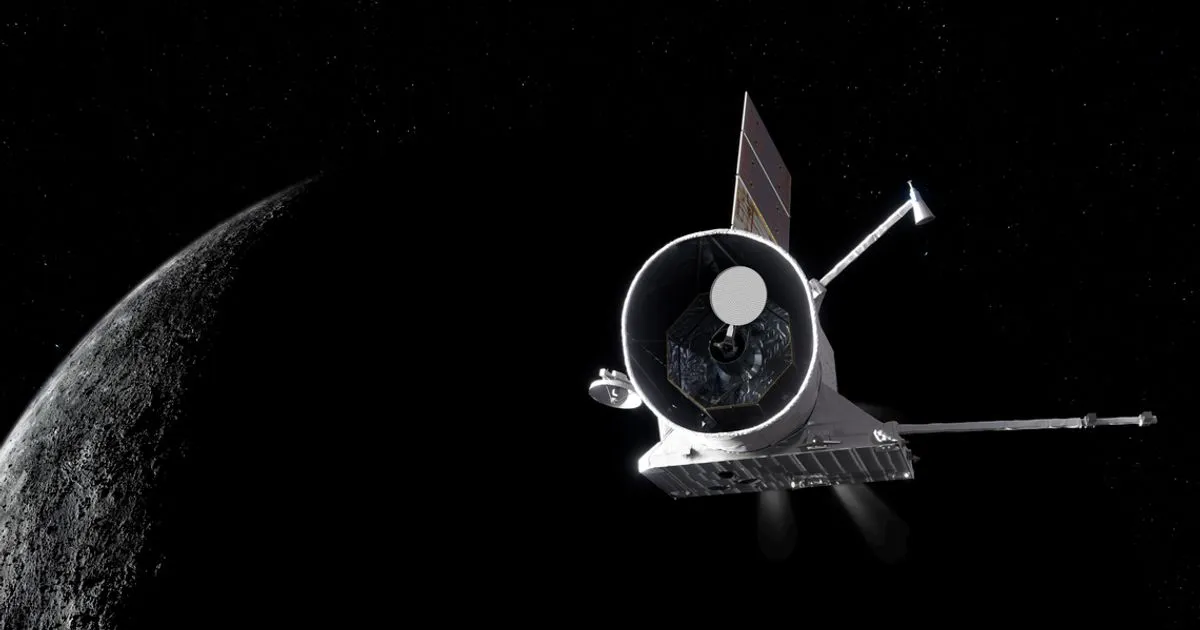 Photo: The Straits Times
Key points
BepiColombo has begun orbiting Mercury after eight years, though ESA said a software issue made a thruster burn shorter than planned.
The European-Japanese spacecraft BepiColombo has begun orbiting Mercury, the solar system's smallest and innermost planet, after a journey of eight years. The European Space Agency confirmed on 21 November that the spacecraft had begun its orbit, and said a day later that a glitch had occurred involving its thrusters. BepiColombo is only the third spacecraft to visit Mercury and just the second to orbit it. Mercury, only slightly larger than Earth's moon, is the least explored of the four planets in the inner solar system. The mission is a joint effort of the European Space Agency, or ESA, and the Japan Aerospace Exploration Agency, or JAXA.
What the software issue did
In a social media post on 22 November, ESA said the spacecraft had a successful entry into orbit, but that during the manoeuvre "the thruster burn was shorter than planned following a software issue." The agency said the spacecraft is safe and that teams at the European Space Operations Centre, or ESOC, are working to understand what happened.
Getting to Mercury took longer than planned. The spacecraft had to fight the Sun's immense gravitational pull, so it kept its brakes on for the entire journey and took a convoluted path, looping once around Earth, twice around Venus and six times around Mercury to slow down enough to get into orbit.
Why the journey took eight years
That journey should have taken seven years, but a problem with BepiColombo's propulsion system extended the voyage by a year. The spacecraft travelled almost six billion miles (10bn km) before arriving at its final destination, where it now flies around the planet. Mercury is an extreme place to operate. It is the closest planet to the Sun, where temperatures can reach 430C and then plunge to -180C, and it is constantly blasted with intense solar radiation. Its surface looks similar to the moon's, with numerous impact craters, smooth terrain and cliffs, some up to 1.6km tall.
The mission will seek to answer questions about Mercury such as why it has a magnetic field, why ice exists in the polar craters of a sun-scorched planet, and what is the nature of enigmatic depressions called "hollows" on its surface. There are thousands of hollows, shallow but with steep sides, and in planetary terms they are young: about 100,000 years old.
What the orbiters will study
Scientists know the hollows are not impact craters, the larger pockmarks caused by colliding space rocks, but they are not sure what the hollows are or how they formed. Mercury also has a huge metal core for its tiny size. Prof Emma Bunce, from Leicester University, a principal investigator on the mission, said one explanation is that the mantle was stripped away in a large collision.
Mercury is about 60% closer to the sun than Earth, so from its surface the sun appears more than three times as large and seven times as luminous as it does from Earth. Its diameter of 4,880km is less than 40% of Earth's diameter of 12,753km. A year on Mercury lasts just 88 Earth days, while a single day there lasts 59 Earth days.
Frequently asked questions
When did BepiColombo begin orbiting Mercury?
ESA confirmed on 21 November that BepiColombo had begun its orbit around Mercury, after a journey of eight years. ESA said on 22 November that a software issue had affected its thrusters.
What went wrong with BepiColombo's thrusters?
ESA said the spacecraft had a successful entry into orbit, but during the manoeuvre "the thruster burn was shorter than planned following a software issue." ESA said the spacecraft is safe and teams at ESOC are working to understand what happened.
Why did BepiColombo take eight years to reach Mercury?
The spacecraft had to fight the Sun's gravitational pull, so it kept its brakes on and took a looping path — once around Earth, twice around Venus and six times around Mercury — to slow down enough to enter orbit.