Helicopter collision near Everest kills Indian tourist, injures two
Two helicopters collided near Mount Everest on 3 November, killing an Indian tourist and injuring a New Zealander and a pilot.
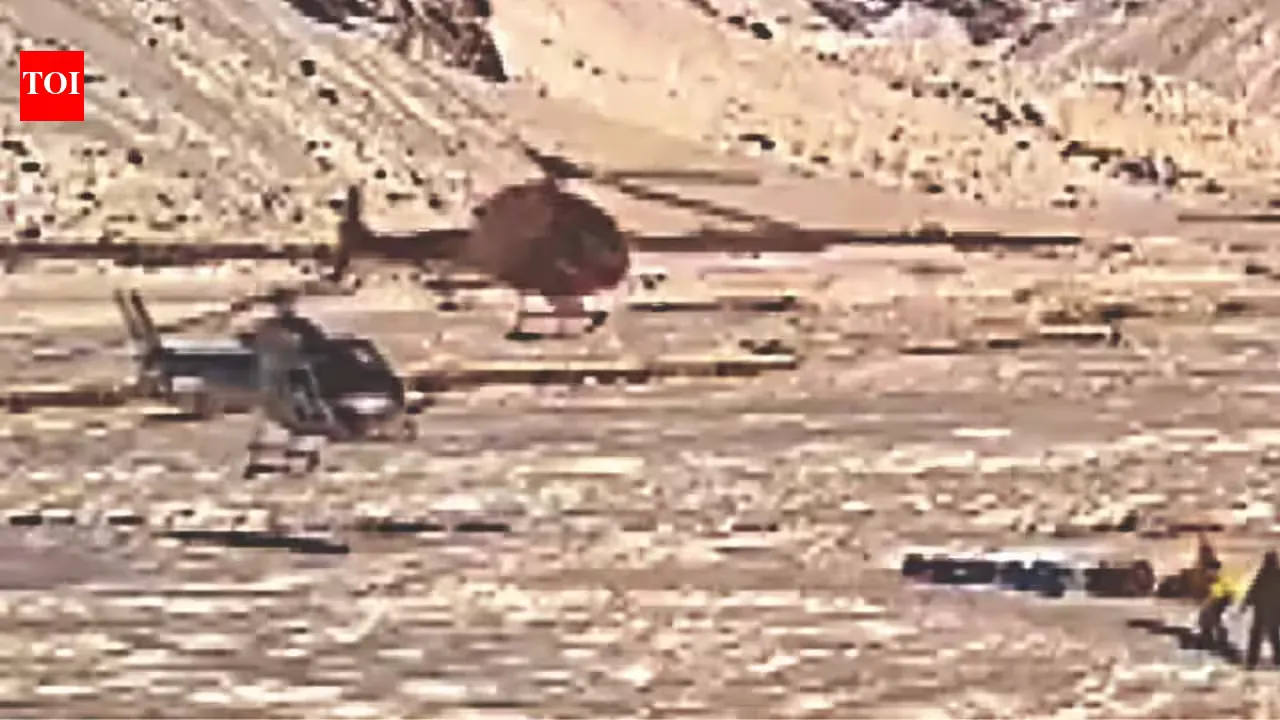 Photo: The Times of India
Key points
Two helicopters collided near Mount Everest on 3 November, killing an Indian tourist and injuring two others.
A 47-year-old tourist from Chennai was killed and two others were injured when two helicopters collided about 10 feet above a helipad near Mount Everest on Tuesday. The accident occurred around 8.11am at Pheriche, 12km south of Everest Base Camp, as one helicopter was evacuating tourists stranded by heavy snowfall and the other was carrying cargo.
The rotor blades of the two choppers struck each other as both aircraft attempted to land, sending them crashing onto the snow-covered helipad. Aviation authorities suspect miscommunication between the pilots, who were operating beyond the coverage of the nearest air traffic control tower in Lukla, gateway to the Everest region. The accident is believed to be Nepal's first mid-air collision involving two helicopters.
Collision details
The deceased was identified as Vasanth Kumar Balaramudu, who died at the scene. Shailesh Krishna Patel (49), a New Zealand citizen, and Fishtail Air pilot Rabindra Prajapati sustained injuries. Balaramudu and Patel were being evacuated aboard a private Fishtail Air Airbus AS350 helicopter, registration 9N-AJR, which had taken off from Gorakshep, a remote settlement near Everest Base Camp at an altitude of approximately 5,164 metres.
The other helicopter, an Air Dynasty AS350 registered 9N-AOD, had flown from Lukla carrying cargo. Its pilot, the sole occupant, escaped unhurt. Verified footage showed the helicopters approaching the helipad from different directions, with one descending faster than the other. The weather appeared clear, with no visible signs of strong winds. People nearby rushed towards the wreckage immediately after the collision.
“Preliminary reports suggest miscommunication between the pilots, as the area is outside the coverage of Lukla Airport’s air traffic control tower and pilots have to communicate with each other,” said Mukesh Dangol, director general of the Civil Aviation Authority of Nepal. “We are recording the statement of the injured pilot,” he added. CAAN spokesperson Gyanendra Bhul said, “It appears the accident happened when two helicopters attempted to land at the same spot.”
Investigation launched
The aviation authority has launched an investigation to establish how both aircraft came to approach the helipad simultaneously. Solukhumbu district official Kaman Singh Thapa Magar also confirmed that the weather was clear at the time but raised the possibility of a technical problem. Prajapati and Patel were flown by a Prabhu Air helicopter to Nepal Mediciti Hospital in Kathmandu Valley.
Air Dynasty confirmed that its pilot was uninjured, contradicting initial reports that both pilots had sustained injuries. Balaramudu’s body was first taken to Lukla and later transported to Tribhuvan University Teaching Hospital in Kathmandu for a post-mortem before repatriation to India. India’s foreign ministry said the Indian embassy in Kathmandu was coordinating with Nepalese authorities to bring back Balaramudu’s remains.
Pheriche, at around 4,300 metres, is a key stop along the Everest trekking route. Heavy snowfall had disrupted trails and left tourists stranded at high-altitude settlements, including Gorakshep, prompting helicopter evacuations. Expeditions are under way on Everest and nearby Ama Dablam. With no road access to the upper Everest region, choppers are widely used to ferry climbers and supplies, besides carrying out rescues.
The collision took place during Nepal's peak trekking season, when helicopters regularly transport hikers and climbers in the Everest region. Heavy snow covered the route before the weather improved on Sunday and thousands of trekkers were able to move around. The Mount Everest base camp trek lasts up to two weeks and runs from the area’s only airstrip, Lukla, to base camp at 5300 metres.
The trek is popular during the northern hemisphere autumn, right after the rainy season and before the harsh winter months. The Civil Aviation Authority of Nepal has launched an investigation, and officials are recording statements from the injured pilot. The accident has raised concerns about helicopter safety in the region, where pilots often operate without direct air traffic control guidance.
Frequently asked questions
What happened in the helicopter collision near Mount Everest?
Two helicopters collided about 10 feet above a helipad at Pheriche, near Everest Base Camp, on 3 November. One was evacuating tourists, the other carrying cargo. The collision killed an Indian tourist and injured two others.
Who was killed in the Everest helicopter crash?
Vasanth Kumar Balaramudu, a 47-year-old tourist from Chennai, India, was killed. He was being evacuated aboard a Fishtail Air helicopter when the collision occurred.
Why did the helicopters collide?
Aviation authorities suspect miscommunication between pilots, as the area is outside the coverage of Lukla Airport's air traffic control tower. The Civil Aviation Authority of Nepal has launched an investigation.