Tens of thousands protest in Prague against media funding reform
Tens of thousands marched in Prague on 25 October 2026 against a bill fast-tracked by parliament that would cut Czech public media funding by about 15 percent.
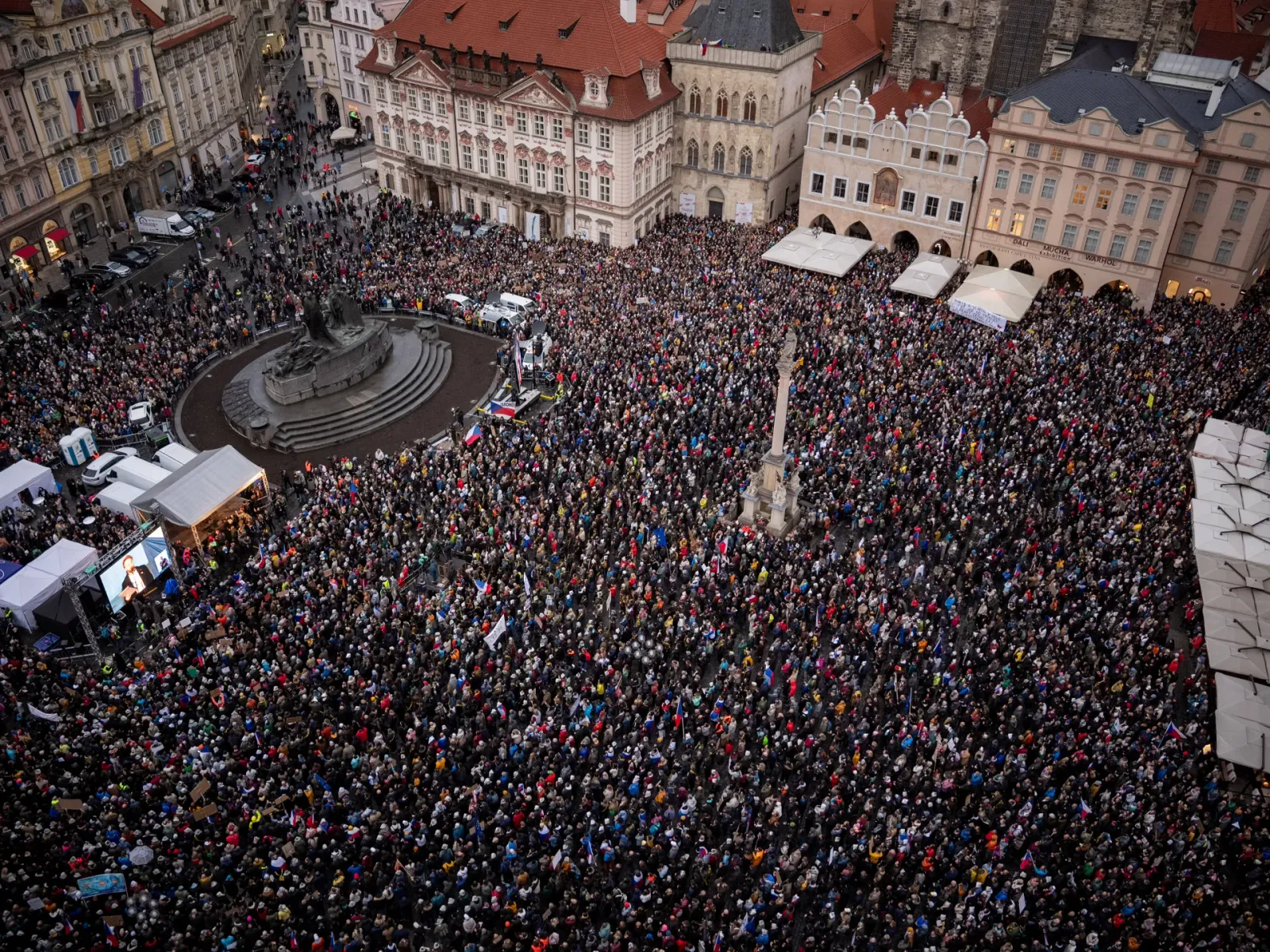 Photo: Al Jazeera
Key points
Tens of thousands protested in Prague against a fast-tracked bill that would replace Czech public media licence fees with state budget funding and cut budgets about 15%.
Tens of thousands of people marched through central Prague on 25 October 2026 to protest a bill that would abolish household licence fees for Czech public media and replace them with direct state budget allocations. The demonstration filled the city's Old Town Square, organised by the initiative A Million Moments for Democracy, days after parliament's lower house fast-tracked the legislation in an overnight vote.
The protest matters because the bill would cut funding for public radio and television by about 15 percent, possibly as early as next year, shifting how Czech Television and Czech Radio are financed from independent licence fees to allocations controlled by the state budget. Critics say the change hands the governing coalition leverage over editorial output; the coalition says funding will be guaranteed by law and editorial independence untouched.
What the bill would change
The bill, proposed by the governing coalition led by billionaire Prime Minister Andrej Babis, would scrap the licence fee that Czech households currently pay to fund public broadcasting and replace it with direct allocations from the state budget. The coalition, which includes two far-right parties — the Motorists' Party and the Freedom and Direct Democracy group — argues the broadcasters need savings and that the funding model change will not affect programme content or news coverage.
Parliament's lower house, the Chamber of Deputies, approved fast-tracking the bill in a rare overnight vote on Saturday, limiting the opposition's ability to debate it before the vote. Demonstrators in Old Town Square chanted "We've had enough", "This must not be allowed to pass", and "4:36" — the early morning hour when the draft was approved. The bill must still pass the upper house before becoming law.
President Petr Pavel criticised the rushed handling of the bill, saying the late-night, weekend process undermined "faith in the good intentions of its initiators." He called public service media fundamental pillars of democracy and said any major reform must be preceded by broad expert and public debate. The opposition has pledged to challenge the legislation in the constitutional court.
Who opposes the reform
The European Broadcasting Union, European Federation of Journalists, Reporters Without Borders and the International Press Institute are among the organisations that have criticised the plans. Protest organisers, in their call to demonstrate, said "The very future of the country for the coming decades is at stake. The government is testing how far it can go." Labour unions, university rectors and churches have also backed public media staff.
Prime Minister Babis rejected the interference claims, writing on X on Saturday that "No one wants to interfere with programming or news coverage" and that funds would be guaranteed by law as mandatory expenditure, so no government could arbitrarily cut them. He has framed the plan as a matter of funding transparency rather than an attack on media independence. Critics compare the reform to actions by populist governments in Hungary and Slovakia.
At Old Town Square, 26-year-old architecture student Petr Cekal said politicians "want to restrict press freedom", which he found "quite alarming." Milan Kotal, 94, said that in his lifetime there had already been two state takeovers of Czech television — by the Nazis during the war and by the Communists until 1989 — and that "Today the government is allowing itself things we cannot accept."
Trust in Czech media sits at around 30–33 percent, according to the Reuters Institute Digital News Report 2026, which also found that public service broadcasters remain the most trusted brands despite increasing attempts by political actors to undermine their credibility. Smaller protests took place in the days before the Prague demonstration, in Brno and other cities.
Public media staffers announced they would go on strike on 3 November, backed by labour unions, university rectors, churches and international media organisations. A larger demonstration is planned at Prague's Letna park on 15 November, two days before the anniversary of the 1989 Velvet Revolution that ended more than 40 years of totalitarian government. The bill now moves to committees for further consideration before the upper house votes.
Frequently asked questions
Why are people protesting in Prague?
Tens of thousands protested on 25 October 2026 against a bill that would abolish household licence fees for Czech public media and replace them with state budget allocations, cutting public radio and television funding by about 15 percent. Critics say the change would let the governing coalition control editorial output.
What does the media funding bill do?
The bill, proposed by Prime Minister Andrej Babis's coalition, would scrap the licence fee Czech households pay to fund public broadcasting and replace it with direct state budget allocations. It passed fast-track approval in the Chamber of Deputies in an overnight vote on Saturday and must still clear the upper house.
When is the next protest and strike?
Public media staffers announced a strike on 3 November, backed by labour unions, university rectors and churches. A larger demonstration is planned at Prague's Letna park on 15 November, two days before the anniversary of the 1989 Velvet Revolution.